
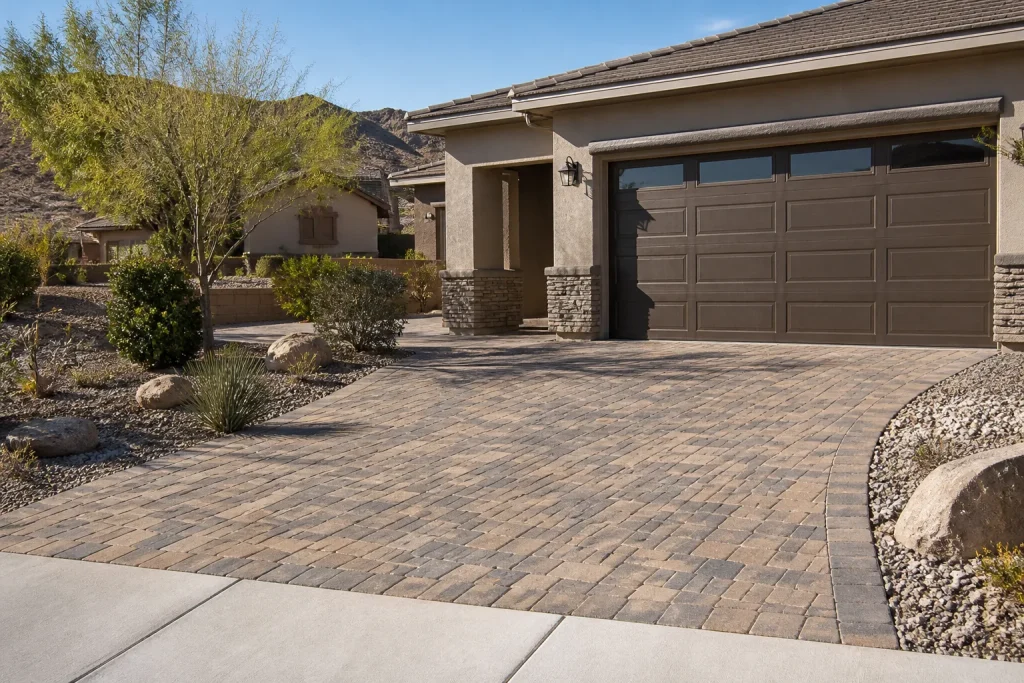
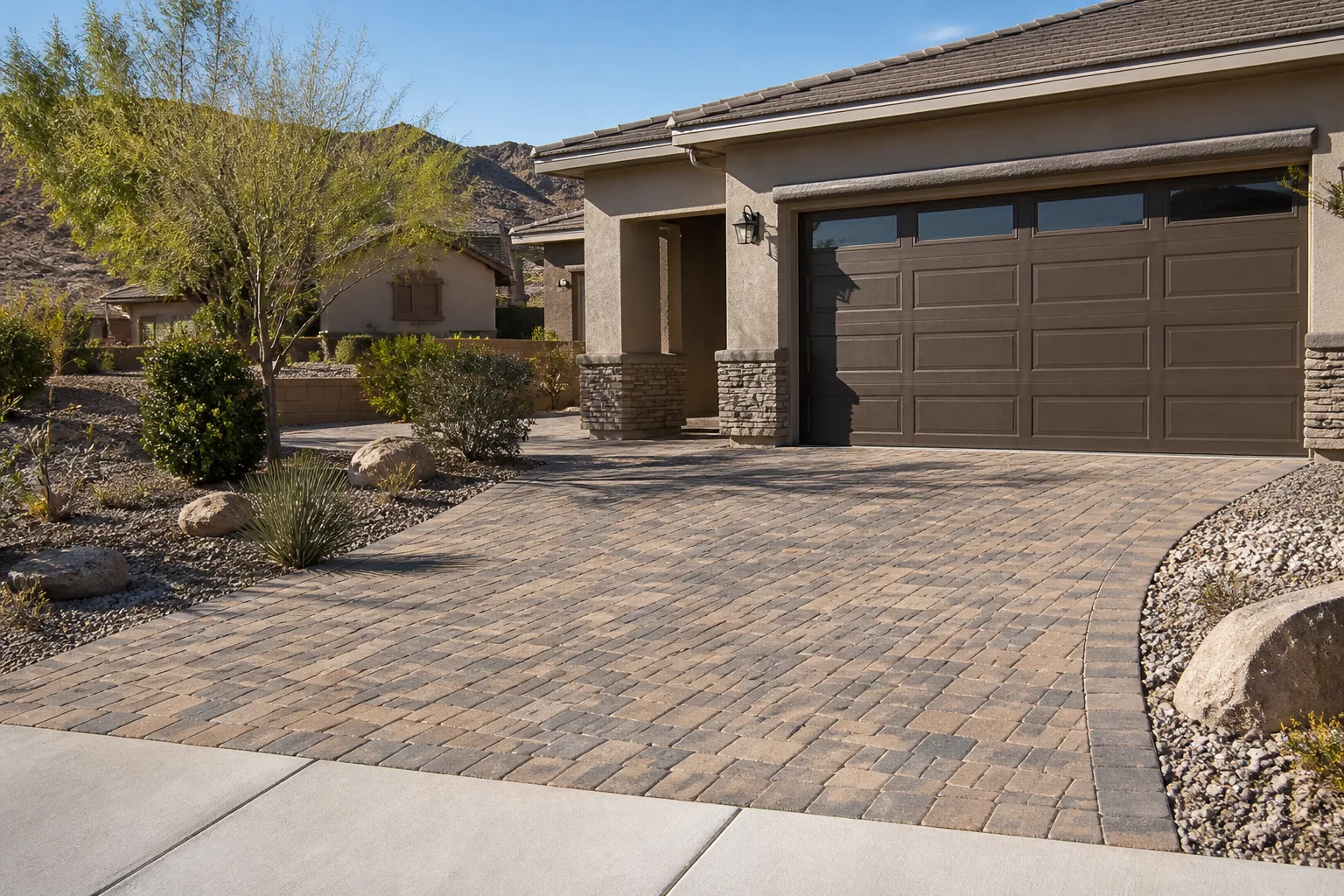
Cover Driveway & Pavers in Las Vegas: A Homeowner’s Guide
Most Las Vegas driveways start cracking within 3 – 5 years not because the pavers were cheap, but because the compacted base under them was laid in the wrong soil conditions. That problem is nearly invisible on install day. The finished surface looks flat and tight, and then two summers later the joints wander and the edges heave. If you’re planning a paver driveway in Las Vegas, the base is the job. The pavers are just what you look at while the base quietly does its work.
If you’d rather have a crew that treats the base like the foundation it is, call (866) 814-4155. Estimates are free.
Why does the base matter more than the pavers in Las Vegas?
Las Vegas sits on soils that punish shortcuts. Caliche – the cemented calcium carbonate layer that forms under so much of the valley – can be hard as concrete in one spot and crumbly in the next. Expansive clays swell when they take on water and shrink when they dry. In a place that gets maybe 4 inches of rain a year but waters lawns and washes cars, that wet-dry swing happens more than people realize. Lay a 4-inch base because a national spec sheet said 4 inches, and you’ve ignored the ground you’re actually building on.
What we look for before we ever set a paver:
- How deep the caliche sits. If it’s near the surface, it has to be broken up and removed, not just graded over.
- Drainage direction. A Las Vegas driveway needs to shed water toward the street or a designed low point, not toward the garage slab or the foundation.
- Soil moisture at compaction. Class II base compacted dry doesn’t lock. It has to be at the right moisture and compacted in lifts, typically 6 inches at a time, checked with a plate compactor.
- Subgrade prep under the base. Soft spots get dug out and replaced, not covered up.
When a base is done right in Mojave soil, a paver driveway can hold up for decades. When it isn’t, no sealer and no premium brand on top will save it. The failure starts underground and shows up at the surface a few summers later.
How does Las Vegas heat change the way pavers behave?
Paver surfaces in direct July sun regularly hit 120°F and higher. That heat does two things worth knowing about. First, it moves the pavers. Concrete and clay pavers expand and contract with temperature swings from 40°F winter mornings to 110°F afternoons, and the joints need room to move. Install them tight with no joint sand and they’ll bind, chip, and heave. Second, it dries out the joint sand. Polymeric sand holds up better than plain sand in Las Vegas, but it still wants a re-top every few years on a sun-blasted driveway.
UV is the other half of the story. Intense Nevada sun fades cheap color through the paver body, not just the surface. A red or charcoal paver that was pigment-through will hold its color far longer than a thin-coated one. Sealing helps slow the fade and keeps sand in place, but it’s maintenance, not a cure. Expect to reseal every 3 – 5 years on a west-facing driveway that takes the afternoon sun.
One more thing heat does: it hides installation sins. A driveway laid in October can look perfect through winter and only reveal soft base and wandering joints once the first real summer bakes it. That’s why the inspection checklist below matters before the base goes down, not after.
Permits versus a handshake install: does it matter at resale?
Yes, and more than most homeowners expect. A permitted paver driveway that was inspected means the base depth, drainage, and compaction were checked by someone whose job is to catch problems – the permit inspector works for you, not for us. That paper trail lives in the county record. When you go to sell, a buyer’s inspector who finds an unpermitted hardscape or a driveway that doesn’t match the site plan can slow the deal or knock the price down.
A handshake install is a driveway with no record and no recourse. If it fails in year four, you’re calling someone who may not answer. We pull permits on eligible driveway and hardscape work, get inspections signed, and put every scope and allowance in writing before a single paver is set. Price changes come as written change orders, not surprise invoices at the end. If a contractor tells you permits are optional for a driveway in Las Vegas, that’s your cue to keep looking. You can see how we approach this on our Driveway & Pavers in Las Vegas page.
Which paver materials hold color longest under Nevada sun?
You’ll see three main families on Las Vegas driveways, and they age differently in this climate:
- Concrete pavers (Belgard, Techo-Bloc). The workhorse for driveways. Pigment goes through the full paver thickness, so a chip doesn’t expose a different color underneath. Density and finish vary by line, and the denser, tighter-faced products hold color longer under UV. This is what we install most for driveways.
- Clay brick pavers. Color is fired in, so it’s the most fade-resistant option over time. They run hotter underfoot and cost more, but a brick driveway in Las Vegas will still look like brick in 20 years.
- Natural stone (travertine, flagstone). Beautiful and cool underfoot, but softer stones can etch and stain, and travertine wants sealing in this sun. Better suited to patios than a driveway taking tire traffic and oil drips.
Whatever you pick, ask for the actual product line and look it up yourself. Materials you can verify beat mystery brands off a van every time.
What should you inspect before the crew pours the base?
This is the window where you have the most leverage, and it closes fast. Walk the site with the crew lead before base material goes down and check these:
- Excavation depth. Ask how deep they dug and why. In expansive or caliche-heavy soil, expect more than the standard 4 inches of base – often 6 to 8 inches compacted, depending on what the soil test shows.
- Soft spots and old fill. Point out any sunken area you’ve noticed. It should be dug out and replaced, not filled and compacted over.
- Slope and drainage. Water should run away from the house and garage, not pool against them. Confirm where it’s meant to go.
- Edge restraint plan. Ask what holds the edges. A driveway without proper edge restraint spreads and loses its joints within a few seasons.
- The written scope. Base depth, paver brand and line, joint sand type, and sealer should all be on paper before work starts. If it isn’t written down, it isn’t in the job.
We pulled one apart over in Centennial Hills a while back where the base was only 3 inches over undisturbed caliche – looked fine for two summers, then the whole apron heaved at the garage. The fix cost more than doing it right the first time would have.
When should you call a pro instead of tackling this yourself?
A paver driveway is heavy work with real structural consequences if the base is wrong. If your site has visible caliche, expansive clay, drainage that runs toward the house, or an existing driveway that’s already heaved and cracked, bring in a crew that knows the local soil. The excavation, compaction equipment, and edge restraint alone put most driveway jobs past what a weekend DIY approach can handle safely and durably. Call (866) 814-4155 and we’ll walk the site with you.
Related services in Las Vegas: a new driveway often pairs with fencing and outdoor structure work. See our Fence Installation in Las Vegas page and our Home Additions & ADU in Las Vegas page if you’re planning a bigger outdoor project. You can also start at the Barrett & Sons Construction Las Vegas home page.
The Bottom Line
In Las Vegas, the paver you pick matters less than the ground you build on. Get the base depth right for caliche and expansive soil, compact it in proper lifts, plan the drainage, pull the permit, and pick a pigment-through paver that can take the UV. Do those things and a driveway can outlast the mortgage. Skip them and no brand or sealer will save you.
Our crew members have up to 28 years of experience reading local soil, and every eligible job comes with permits pulled, inspections signed, written change orders, and our 90-Day Done Right Promise in writing on the contract. We also offer $40 off any repair over $200, a free second opinion on any written estimate, no trip charge inside the county, and a permanent 10% senior and veteran discount. If you’re in Las Vegas and need help, Barrett & Sons Construction Las Vegas offers free estimates – call (866) 814-4155.
Frequently Asked Questions
Most paver driveways in Las Vegas run roughly $12 to $22 per square foot installed, depending on base depth, paver line, and site conditions. Caliche removal or thicker base pushes the number up. Call (866) 814-4155 for an exact quote – estimates are free.
Usually because the base was laid too shallow for local caliche and expansive soil, or compacted dry in the wrong conditions. The pavers aren’t the problem – the ground under them is. Call (866) 814-4155 and we’ll tell you what we see on your site.
Many driveway and hardscape jobs do require a permit, and pulling one gives you an inspected record that helps at resale. We pull permits on eligible work and get inspections signed. Call (866) 814-4155 to find out what your project needs.
A properly based and permitted paver driveway can hold up for decades, though you’ll want to re-top joint sand and reseal every 3 to 5 years on a sun-facing driveway. Call (866) 814-4155 for a free estimate.
Written by the team at Barrett & Sons Construction Las Vegas.
Need Construction Help?
Call Barrett & Sons Construction Las Vegas - licensed & insured, here with fast after-hours help in Las Vegas.
(866) 814-4155