
Last updated November 17, 2026
 Driveway & pavers
 Kitchen remodeling
 Bathroom remodeling
 Home additions & ADU
 Roofing
 Windows & doors
 Fence
Free written scope consultation - allowances, timeline, and change-order rules on paper before a single trade is scheduled
How Long Does Driveway & Pavers Take? Timelines and What to Expect
Here’s the part most estimates leave out: a properly built paver driveway gets a mandatory pause after base compaction, and nothing gets laid on top of that base until it has held. In a Las Vegas summer, that 24-hour hold is the difference between a driveway that’s still flat next Thanksgiving and one that’s already dipping where the tires roll. Crew size barely matters. What actually sets your finish date is cure windows, settling time, and how early the permit gets pulled. Below is the real day-by-day sequence for a standard Las Vegas driveway paver project, why summer jobs run longer than fall jobs, and what “done” honestly means at each stage.
Quick Answer
A standard 1,200 square-foot driveway paver project in Las Vegas typically takes 5 to 7 working days from demo to final sealer, plus a 2 to 4 week permit and scheduling window before that. Summer installs often stretch to 7 to 10 working days because heat slows compaction cure and shortens safe working hours. Anyone quoting a 2-day turnaround on that size of driveway is skipping a step.
Styles & brands we work with
- Kitchen remodeling
- Bathroom remodeling
- Home additions & ADU
- Roofing
- Windows & doors
- Driveway & pavers
- Fence
Table of Contents
- The Day-by-Day Breakdown of a Las Vegas Paver Driveway
- How Clark County Permit Timing Affects Your Start Date
- Why Summer Installs Take Longer Than Fall Installs
- What “Done” Actually Means: Four Stages, Not One
- How Square Footage Changes the Timeline
- Red Flags in Contractor Timelines
- Material Choice and Its Effect on Schedule
- Aftercare: What Happens After the Crew Leaves
The Day-by-Day Breakdown of a Las Vegas Paver Driveway
A 1,200 square-foot driveway, about the size of a two-car pad with a turnaround, follows a sequence that doesn’t change much from job to job. The pace does. Here’s the realistic schedule we build a project around, and it’s the same one you should expect any honest Las Vegas paver contractor to explain before you sign.
- Day 1 – Demo and haul-off. Existing concrete or asphalt comes out, debris leaves the site. On older Las Vegas properties, this is also when irrigation lines and gas stubs get marked and protected.
- Day 1-2 – Excavation to grade. The crew digs down 8 to 10 inches for the base plus the paver thickness. Slopes get set to drain toward the street or a swale, not toward the garage, which matters more here than in wetter climates because summer monsoon bursts arrive fast.
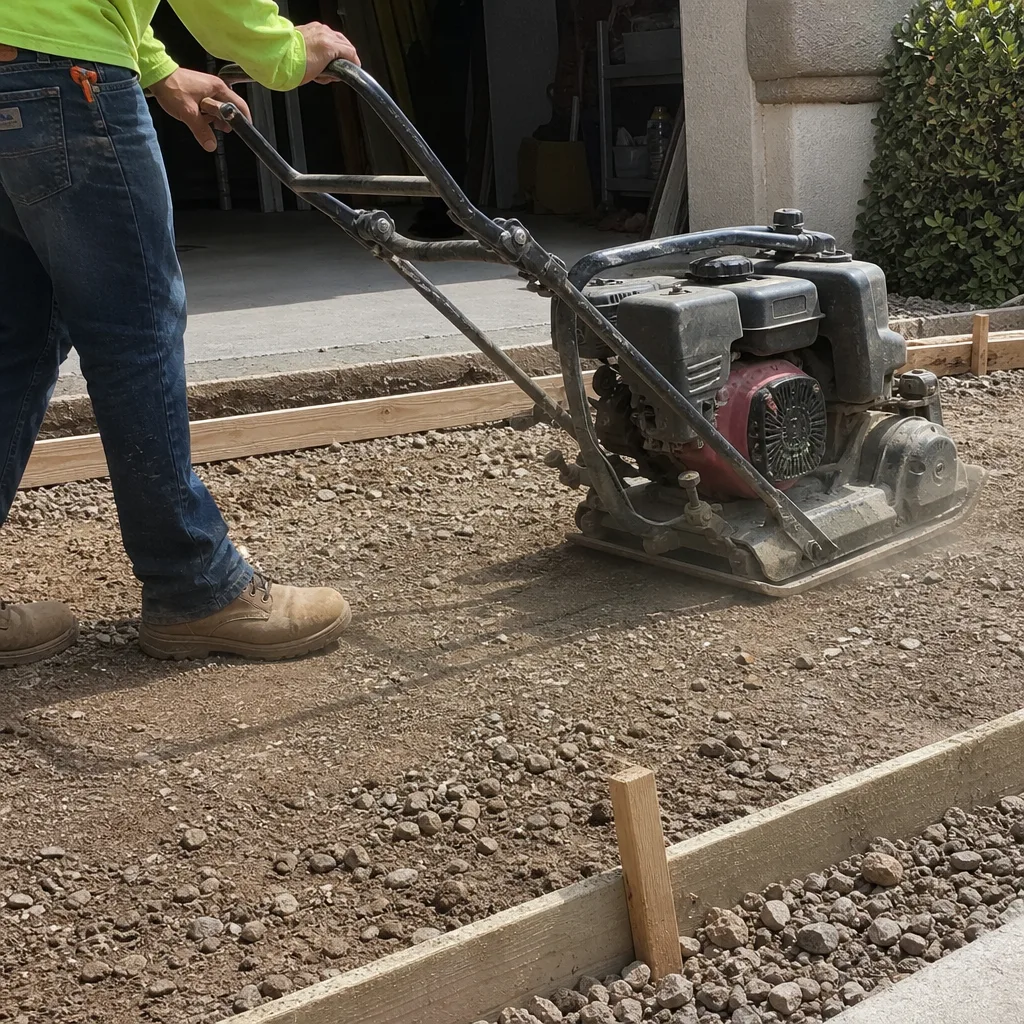
- Day 2-3 – Base install and compaction. Class II road base or crushed aggregate goes down in lifts of 2 to 4 inches, each one compacted with a plate compactor. This is the step that determines whether the driveway lasts.
- Day 3-4 – Base settling hold. A minimum 24-hour hold after final compaction. In July and August, that window sometimes stretches to 36 hours because the ground is radiating heat and the base hasn’t stabilized underneath.
- Day 4-5 – Edge restraint and bedding sand. Plastic or concrete edge restraint gets pinned, then a screeded layer of bedding sand goes down.
- Day 5-6 – Paver setting. Pavers get laid, cut at the edges, and the pattern gets checked against the plan. On a 1,200 square-foot pad, that’s roughly 3,600 to 4,500 individual pieces depending on size.
- Day 6 – Joint sand and compaction. Polymeric joint sand gets swept in and the whole field gets compacted again to lock the joints.
- Day 7 – Sealer and walkthrough. Sealer goes down if you opted for it, and the crew does a final walkthrough with you.
That’s 5 to 7 working days in mild weather. Add a day or two in summer, and add a week or more if the permit wasn’t pulled before demo day.
How Clark County Permit Timing Affects Your Start Date
The clock on your project starts well before a single paver gets touched. In Clark County, a driveway replacement that changes the footprint, alters drainage, or touches the right-of-way typically needs a permit, and turnaround runs 2 to 4 weeks depending on how backed up the review desk is and whether the plans are clean on the first pass. If your driveway ties into a county-maintained street, expect the review to take longer, not shorter.
Here’s why the order matters. A contractor who pulls the permit before scheduling demo has a clean work window. A contractor who demos first and pulls the permit after leaves you staring at a dirt pit for three weeks while the county reviews. We’ve seen both, and the second version is where homeowners start calling other people.
Two things you should confirm before work begins:
- The permit is issued and posted, not “in progress.”
- The plan set shows drainage direction and the right-of-way connection if there is one.
You’ll find the same discipline across our other trades. The Barrett & Sons Construction Las Vegas home page lays out how permits and inspections work on every eligible project, and the same rule applies to a driveway.
Why Summer Installs Take Longer Than Fall Installs
A July install in Las Vegas is not the same job as a November install. The work is identical. The conditions aren’t.
Compaction cure. Base material compacts to a stable density best within a specific moisture band. In summer, the top inch of base dries out within an hour of watering, so crews water and compact in smaller sections and often shut down the base prep by 11 a.m. to avoid baking it.
Adhesive and sealer set times. If a joint sand stabilizer or edge adhesive is part of your spec, “set” depends on temperature. At 110°F surface temps, an adhesive that cures in an hour in October takes three in July.
Crew working hours. Practical working windows shrink. Summer crews start earlier and stop mid-afternoon because paver surface temps can reach 140°F to 150°F, which means boots melt and hands don’t work fast enough. A full day in October might be 10 productive hours. A July day might be 6.
Monsoon interruptions. July through September brings afternoon storms that can flood an open excavation in ten minutes. When that happens, the base gets re-graded and re-compacted, and the schedule slides.
Fall installs (October and November) and spring installs (March and April) are the most predictable windows in Las Vegas. If your timeline is flexible, aim for those months. If it isn’t, plan for the extra days.
What “Done” Actually Means: Four Stages, Not One
Most timeline problems come from a mismatch in what “done” means. To a contractor, “done” might mean the last paver set. To you, “done” might mean the car’s back in the garage. There are four distinct stages in between.
- Pavers set. Every piece is in place and cut to fit. You can look at it. It’s not drivable.
- Pavers settled. The field has been compacted, joint sand swept in, and any low spots lifted and corrected. This is where the surface wants a day of no traffic to fully lock.
- Joints locked. Polymeric sand has been activated (water-cured) or a standard sand has been compacted into the joints and set. Polymeric stabilizers typically need 24 hours of dry weather before traffic.
- Sealer fully cured. If you opted for a sealer, dry-to-touch is different from cured. Sealer typically wants 24 to 48 hours before foot traffic and up to 72 before vehicles, depending on the product and the temperature. The manufacturer’s spec is the guide, not the contractor’s preference.
Bottom line: even after the crew pulls out, plan on 2 to 3 days of no vehicles on the driveway before you’re fully back to normal. That’s not padding. That’s the product.
How Square Footage Changes the Timeline
Timeline scales roughly with square footage, but not linearly. Fixed costs of time (permit, mobilization, demo day, a single base hold) stay the same regardless of size, so a small job looks “slow” and a large job looks “fast” per square foot.
| Driveway size | Working days (mild weather) | Working days (summer) |
|---|---|---|
| 400-600 sq ft | 3-4 | 4-5 |
| 600-1,000 sq ft | 4-5 | 5-7 |
| 1,000-1,500 sq ft | 5-7 | 7-9 |
| 1,500-2,500 sq ft | 7-9 | 9-12 |
| 2,500+ sq ft | 10-14 | 12-16 |
These ranges assume a straight or gently curved driveway with no major drainage work. Add days if the drive crosses a utility easement, needs a retaining edge on a slope, or has an existing concrete pad that’s thicker than usual (we’ve pulled 8-inch pours out of older Vegas neighborhoods that were spec’d for RV parking).
If your project grows into a larger entry or parking area, or pairs with an ADU or addition that will change how you use the space, the Home Additions & ADU in Las Vegas page covers how those timelines run in parallel, and whether it makes sense to schedule the driveway and the build together.
Red Flags in Contractor Timelines
A short quote isn’t automatically suspicious. A short quote with no broken-out steps usually is. What you’re checking for is which steps get compressed or skipped.
- “Two days, done.” On a 1,200 square-foot driveway, that means somebody skipped the base hold, the compaction pass, or both. That’s the driveway that dips by fall.
- No mention of base depth. Ask what base depth they’re installing. If the answer isn’t a number (typically 4 to 6 inches of compacted base for a residential driveway), they don’t have a plan.
- “Permits aren’t needed for a driveway.” Sometimes true, sometimes not. If they say it without checking, they’re guessing.
- No written start date, only “next available week.” A written start date is a commitment. A window is not.
- Sealer and traffic windows not explained. If they don’t tell you how long the sealer needs to cure, they either aren’t sealing or they expect you to find out the hard way.
- No allowance for site conditions. A contractor who quotes the same timeline for every driveway hasn’t looked at yours.
Every legitimate schedule should have room for the hold times. If it doesn’t, the schedule is wishful.
Material Choice and Its Effect on Schedule
Paver material doesn’t move the timeline much, but the brand and pattern can shift the schedule by a day either way. A complex running-bond or herringbone pattern in a small paver takes longer to lay than a large-format slab. A large 24×24 slab can go down faster but needs more careful base work because there’s no flexibility in the field.
We install Belgard, Techo-Bloc, and Tremron pavers on Las Vegas driveways, and each one has a slightly different cutting and setting cadence. A Belgard product with a factory finish typically shows well with less field cutting on straight runs. Techo-Bloc’s textured profiles hide tire marks better in a driveway but take a bit more care to set clean. Tremron is often the practical choice for larger projects where supply depth matters, because a mid-project stock-out is what actually blows a schedule. If your job calls for a specific paver that has to be ordered, lead time is real, and it typically runs 1 to 3 weeks – quote the timeline from the delivery date, not the demo date.
If your project also needs a replacement fence or a new border along the drive, the Fence Installation in Las Vegas page covers sequencing so the fence goes in before the pavers or as a coordinated second phase.
Aftercare: What Happens After the Crew Leaves
The final walkthrough is not the end of the project. It’s the end of the visible work. Here’s what to expect after that, and what to watch for so a small issue doesn’t become a bigger one.
- Days 1-3 after sealer: No vehicle traffic, minimal foot traffic. If it rains in this window (rare but possible in monsoon season), watch for pooling and call if water sits for more than a few hours.
- Weeks 1-4: A few pieces may settle slightly as base continues to consolidate. This is normal. A good contractor will come back and lift-and-reset those pieces free within the first 90 days.
- Months 1-12: Joint sand may need a top-off after the first summer and first winter. That’s routine maintenance, not a defect.
- Year 1 and beyond: Reseal every 2 to 4 years depending on sun exposure and traffic. Las Vegas sun is hard on sealer; a south-facing driveway will need it sooner than a shaded one.
If your driveway pairs with a new walkway or patio going in at the same time, we plan them as one continuous schedule so the base work happens once. That’s the kind of sequencing you’ll see reflected on our Driveway & Pavers in Las Vegas page.
Common Mistakes to Avoid
- Scheduling demo before the permit is issued. In Clark County, this is the number-one way a 6-day job becomes a 6-week job. Confirm the permit is posted before anyone swings a sledgehammer.
- Planning a July install to “get it done.” Summer builds are slower and more weather-exposed than fall builds. If you have flexibility, use it.
- Picking a contractor on day count alone. The lowest day count is often the highest risk. Ask which steps are being compressed to hit that number.
- Driving on the driveway the evening it’s finished. The polymeric joint sand needs a dry window. One impatient evening can mean loose joints by the weekend.
- Skipping the base depth conversation. Base is invisible after day four, and it’s the single biggest driver of how long the driveway actually lasts. Get the depth in writing.
- Not asking about change orders. If a scope change happens mid-job, you want a written change order before work continues, not a surprise number on the final invoice.
- Choosing a paver with a supply lead time you can’t wait for. A beautiful paver that arrives in five weeks blows the schedule worse than a slightly less exotic one that ships in three days.
See the difference
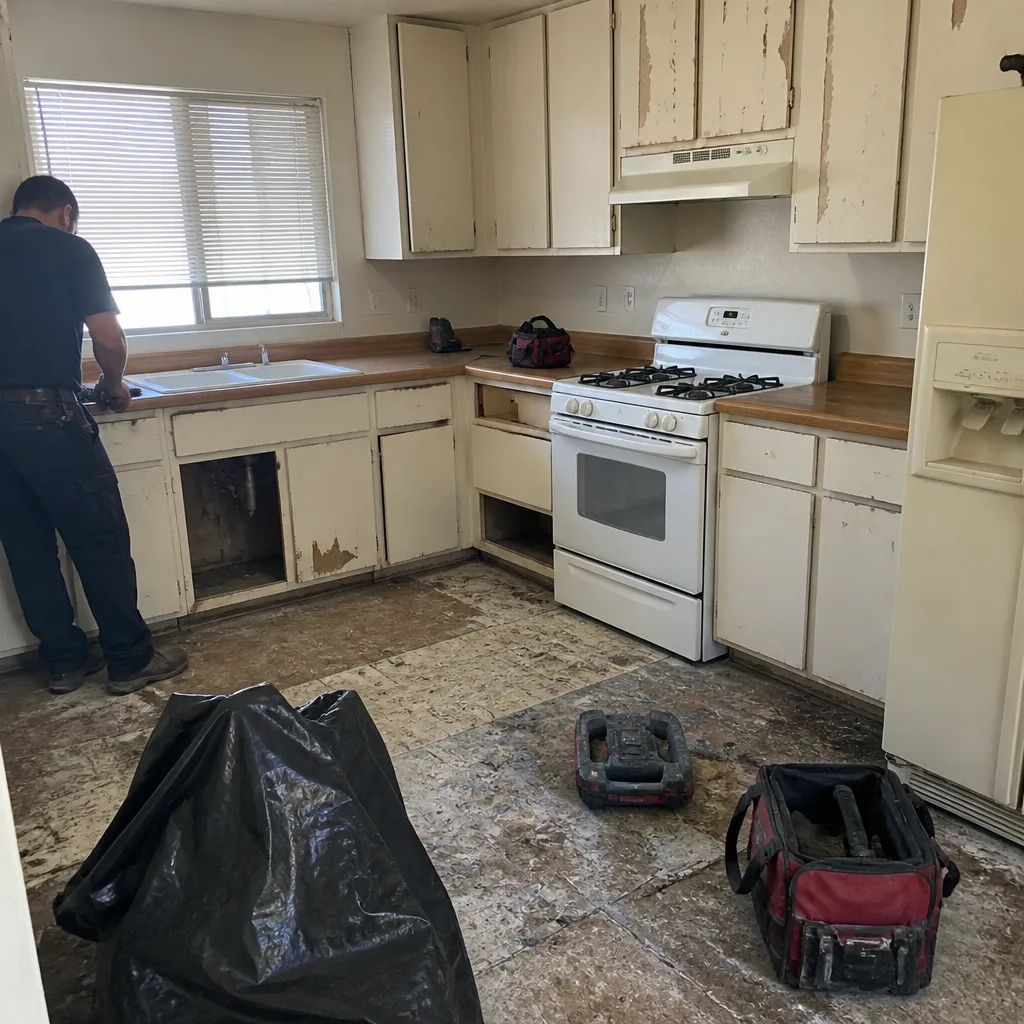 Before
 After
 Before
 After
 Before
 After
When to Call a Professional
Pull in a professional for any driveway that needs excavation, base replacement, drainage correction, or a permit. Pavers on a bad base are just a temporary fix with a long demo day attached. If your existing driveway has settled more than an inch, if water is pooling toward the garage, if you’re in an unincorporated Clark County neighborhood where the right-of-way rules are particular, or if the driveway is more than 400 square feet, that’s a professional job, and it’s a job where the schedule matters as much as the price. Barrett & Sons Construction Las Vegas offers free estimates in Las Vegas – call (866) 814-4155. Bring the timeline questions from this guide, and you’ll get straight answers before anyone touches the ground.
Frequently Asked Questions
Expect 5 to 7 working days for a standard 1,200 square-foot driveway in mild weather, and 7 to 10 working days in summer. That’s the working time on site. Add 2 to 4 weeks before demo day for permit review and scheduling. Call (866) 814-4155 for a free estimate specific to your driveway.
Compacted base material needs a settling window to reach stable density under its own weight and the ambient moisture. Skip that hold and the base continues to consolidate after pavers are set, which causes the rolling dips and edge lift that show up a few months later. In Las Vegas summer heat, that window sometimes stretches to 36 hours. Call (866) 814-4155 if you want an exact schedule for your project.
No. Even after the crew pulls out, plan on 2 to 3 days before vehicle traffic. Polymeric joint sand needs 24 hours of dry weather to set, and sealer needs up to 72 hours to fully cure depending on the product and temperature. Call (866) 814-4155 for a written traffic-ready date on your job.
Often yes, especially if the footprint changes, the drainage grade changes, or the driveway touches a county-maintained street or right-of-way. Turnaround is typically 2 to 4 weeks. The permit should be issued and posted before demo begins. Call (866) 814-4155 and we’ll tell you what’s required for your address.
Yes, typically by 1 to 3 working days on a standard-size driveway. Summer heat shortens the compaction window, slows adhesive and sealer cure, cuts productive crew hours, and adds monsoon risk. October, November, March, and April are the most predictable windows in Las Vegas. Call (866) 814-4155 to line up a fall or spring slot.
An afternoon monsoon can flood an open excavation and require re-grading and re-compaction, so the schedule slides by a day or more. If it happens after the pavers are set but before the joints are locked, the crew can usually re-sweep and re-activate sand within 24 hours. Call (866) 814-4155 if a storm hits mid-job and you’re not sure what to do.
The Bottom Line
The single number most homeowners want (how many days?) is the least useful number in the estimate. What matters is whether the schedule accounts for the base hold, the compaction passes, the permit timeline, and the sealer cure window. A 1,200 square-foot paver driveway in Las Vegas runs 5 to 7 working days in good weather and 7 to 10 in summer, with 2 to 4 weeks of permit and scheduling lead time before that. Trust the contractor who shows you the sequence, not the one who promises the weekend. A written schedule is the cheapest insurance you’ll ever buy on a driveway. Call (866) 814-4155 to schedule your free estimate.
Written by the team at Barrett & Sons Construction Las Vegas.